

What Do Black Soldier Flies Do?
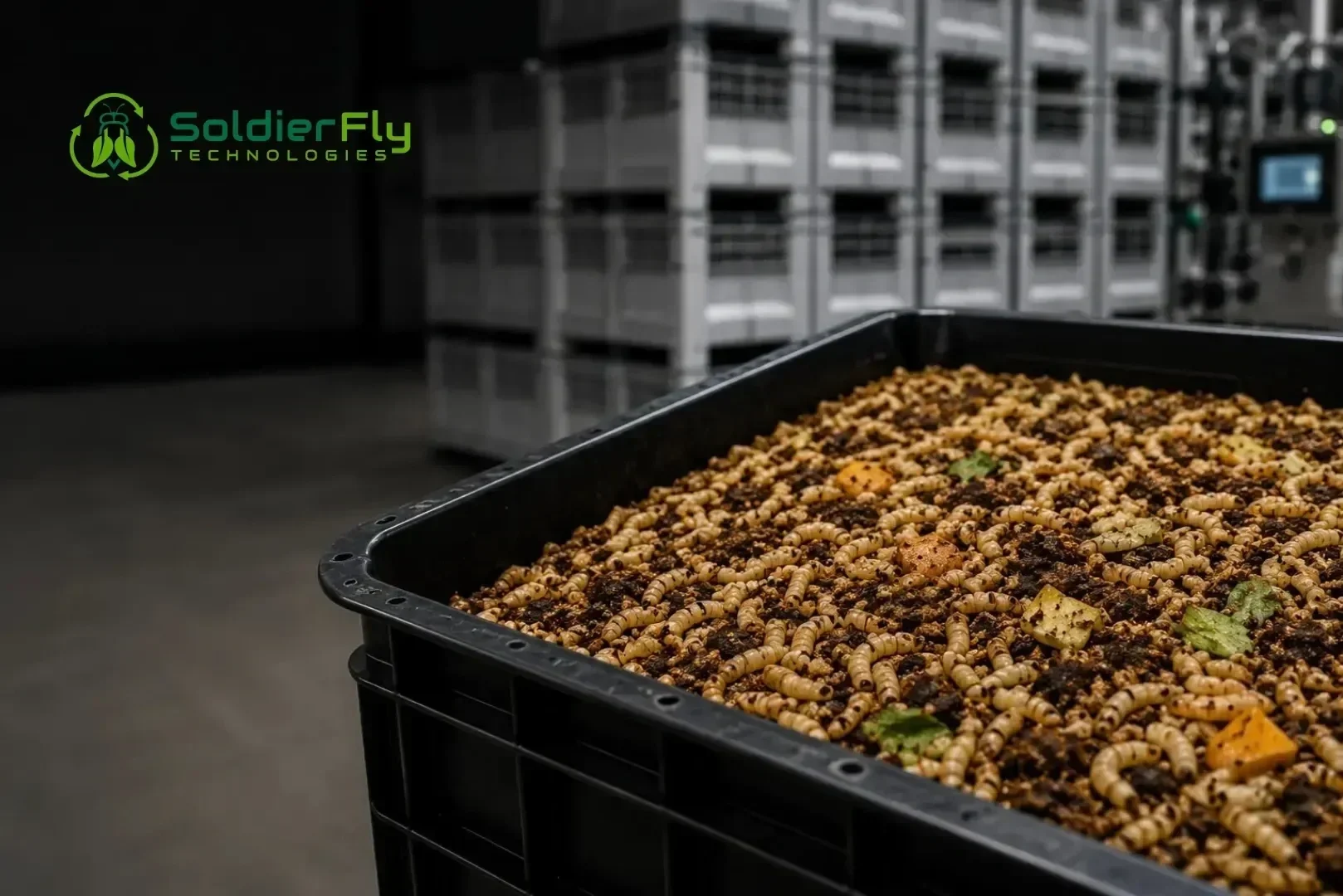
Nature's Organic Waste Recycling Experts
Black Soldier Flies (BSF) play a vital role in organic waste recycling by converting food waste, agricultural residues, and manure into valuable insect protein and nutrient-rich fertilizer. Learn how these remarkable insects support sustainable agriculture and the circular economy.
What Are Black Soldier Flies?
Black Soldier Flies(Hermetia illucens) are beneficial insects best known for their ability to recycle organic waste efficiently. Native to tropical and temperate regions, they have become an important part of modern sustainable agriculture because their larvae rapidly convert organic material into valuable resources.
Unlike common houseflies, adult Black Soldier Flies do not bite, sting, spread disease, or feed on human food. Their primary role is reproduction, while the larvae perform the valuable work of consuming organic waste.
How Do Black Soldier Fly Larvae Process Organic Waste?
The larvae are the engine behind the Black Soldier Fly's remarkable recycling ability.
Once hatched, they consume a wide range of organic waste materials, including:
food scraps
fruit and vegetable waste
agricultural by-products
food processing waste
livestock manure (where appropriate and permitted)
As they feed, the larvae rapidly break down organic matter into insect biomass and a nutrient-rich residue that can be further processed for agricultural applications.
This natural bioconversion process helps reduce waste volume while recovering valuable nutrients that would otherwise be lost.
Why Are Black Soldier Flies Important?
Black Soldier Flies provide environmental and economic benefits across multiple industries.
Reduce Organic Waste
BSF larvae significantly reduce the volume of organic waste sent to landfill, helping lower methane emissions associated with decomposing food waste.
Produce Sustainable Protein
Harvested larvae contain high levels of protein and beneficial fats, making them an increasingly important ingredient for animal feed applications.
Generate Valuable Fertilizer
After feeding, the remaining frass and organic residue can contribute nutrients that support soil health and plant growth.
Support the Circular Economy
Instead of treating organic waste as a disposal problem, BSF farming transforms it into valuable agricultural resources.
The Black Soldier Fly Life Cycle
Understanding the Black Soldier Fly life cycle helps explain why the species is so effective at waste conversion.
The life cycle includes four stages:
Egg
Larva
Pupa
Adult fly
The larval stage is responsible for nearly all feeding activity and organic waste conversion. Under suitable environmental conditions, the complete life cycle typically takes around four to six weeks, although this can vary depending on temperature, nutrition, and production conditions.
Commercial Applications of Black Soldier Fly Farming
Today, Black Soldier Fly farming is being adopted across a wide range of industries.
Common applications include:
pet food ingredients
sustainable agriculture
research and education
Commercial production systems allow organizations to process large volumes of organic waste while creating valuable agricultural products.
Why SoldierFly Technologies Focuses on Black Soldier Flies
At SoldierFly Technologies, Black Soldier Flies are more than an interesting insect—they are the foundation of scalable biological recycling systems.
The company develops commercial Black Soldier Fly farming solutions that combine breeding, larvae rearing, automation, digital traceability, and professional training to help organizations build efficient insect farming operations.
This integrated approach enables customers to reduce organic waste while producing valuable insect protein and fertilizer using commercially proven production methods.
Conclusion
Black Soldier Flies play a vital role in modern sustainable agriculture by naturally converting organic waste into valuable resources.
Their ability to recycle organic materials, produce high-quality insect protein, and support circular economy principles has positioned them as one of the world's most promising biological waste management solutions.
As commercial adoption continues to grow, Black Soldier Fly farming is helping organizations improve sustainability while creating new economic opportunities across agriculture and food production.
Interested in commercial Black Soldier Fly farming?
Explore our commercial BSF farming systems, learn about the SoldierFly Technologies Academy, or contact our team to discover how Black Soldier Fly technology can support your sustainability goals.
Further Reading
About the Author
David Fluker is the CEO of SoldierFly Technologies and a second-generation insect farmer with roots in Fluker Farms (est. 1956). With more than a decade of hands-on experience in Black Soldier Fly bioconversion, David leads the development and licensing of scalable BSF farming systems that transform organic waste into sustainable insect protein and organic fertilizer. His work focuses on practical engineering solutions, modular automation, and commercial production systems that help organizations deploy profitable and sustainable Black Soldier Fly operations worldwide.
Learn more about the SoldierFly Technologies team.
Related Articles
10 Cool Facts About the Black Soldier Fly
BSF Farming: From Manual to Full Automation with BOOTS
Black Soldier Flies: A Superfood for Chickens
Are Soldier Flies a Threat to Humans?
